
When visiting Montmartre, I was not prepared for the amount of uphill walking that this would entail. Running a little late for lunch, when I was greeted with the task of climbing up two blocks of steep uphill, my heart almost gave up. However, the hills were truly just a byproduct of this neighborhood and its revolutionary history.

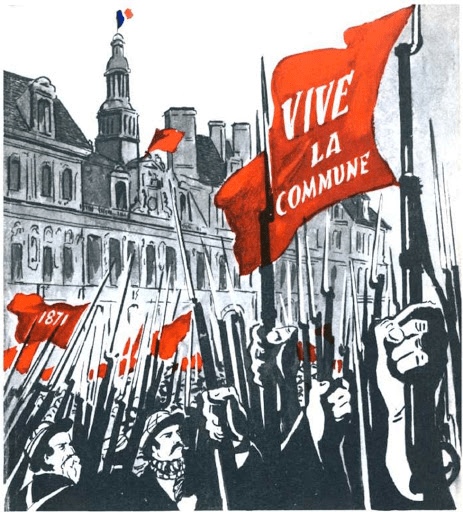
The Paris Commune, to be completely honest, still confuses me in some ways. I know that there was a revolutionary government that ruled Paris in the late 19th century and that lasted only for 72 days. I also understand that this revolution was defined by their use of barricades and violence. Visiting Montmartre, I imagined the streets being filled with mass graves and blood from both the Prussian forces and the Commune actors. Although this revolution was motivated to improve the conditions for Parisian peoples, they eventually fell to the Prussian government, the government of France during this period.

An interesting aspect of the Montmartre walking tour was talking about the legacy of Louise Michel. Michel was a feminist and women's rights activist during the Paris Commune. On the walking tour, Professor Bjork-James stopped us and gave a brief summary of her life and legacy. She was a leader of women during the commune and became part of the national guard for the movement. Additionally, she held a very leftist ideology, leading to her belief in a socialist and people-led government. After the fall of the Paris Commune, Michel was tried and exiled to New Caledonia. There, she preached about equal rights among the native peoples and French colonists. Before the end of her life, Michel wrote a memoir of her experiences in the Commune and beyond. Michel also opened a school that was known for their progressive methods of teaching and which is still open. Michel particularly interested me because of her views about women’s equality and the fact that she was not shy in her opinions. In the 19th century, being a feminist was extremely dangerous and I aspire to be someone similar to her, not scared to express what I believe is right.
After walking further up this mountain, we finally reached the summit at the Basilique du Sacré-Cœur. Sacré-Cœur was built after the Commune and was built out of white stone. The white stone seems to have a deeper meaning, as Sacré-Cœur was built to put an end to the Commune the white stone could signify the end of bloodshed or the color of the movement, red. On the inside of this church, there was a large statue of Christ standing with his arms wide. The church itself was very beautiful however, I could not get over that this building was built to atone for the lives lost during the Commune.
Exploring Montmartre expanded my knowledge of the Paris Commune and the people who were a part of the movement, despite our tour getting cut short by the downpour that soaked me head-to-toe. Overall, this area speaks for the importance of rebellion in France even today, inspiring others to do what the Commune did over 150 years ago.



 Revolutionary Cities