
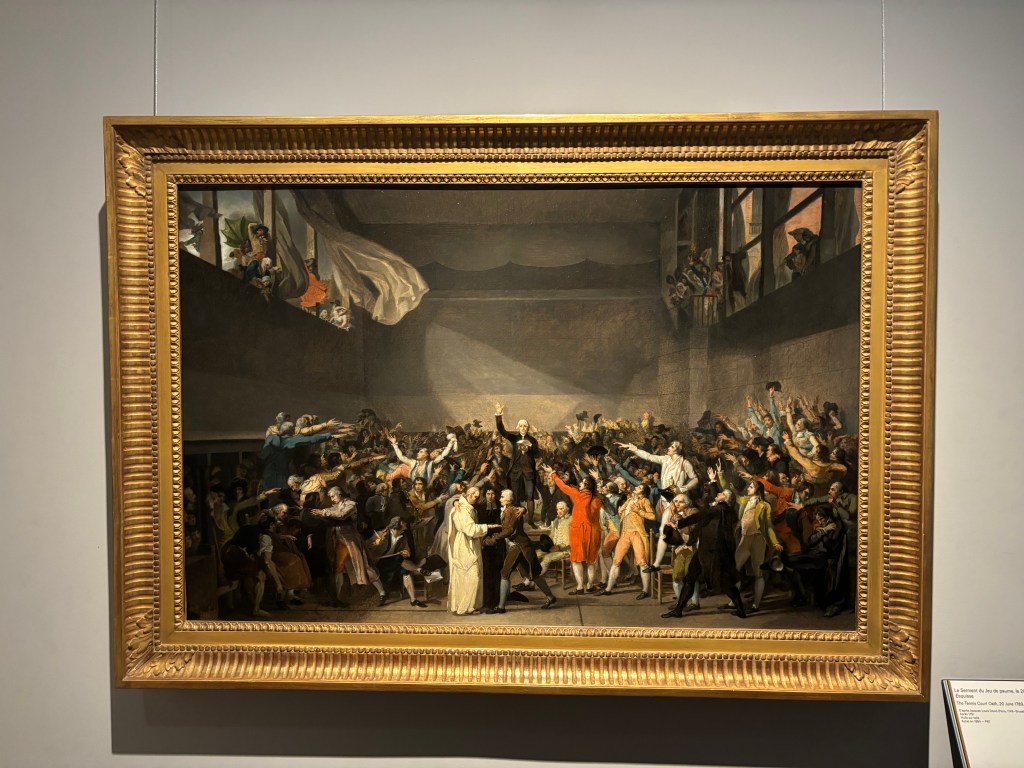
This sketch by Jacques-Louis David is called Le Serment de Jeu de paume or The Tennis Court Sketch. It depicts a scene from June 20, 1789. June 20 was a pivotal moment in the French Revolution when members of the Third Estate, feeling marginalized and disregarded by the traditional powers of the king and the two other estates, pledged not to disband until a new French constitution was established.
Originally called to solve France’s severe financial position in May 1789, the Estates-General rapidly devolved into a power struggle for representation. The First (clergy) and Second (nobility) Estates were at odds with the Third Estate, which stood for commoners and a broad segment of society. Locked out of their regular meeting venue and frustrated at being outvoted by the two affluent estates, the Third Estate moved to an indoor tennis court nearby. Here, they swore the fabled oath that effectively established the National Assembly and signaled the end of the Ancien Régime.
Jacques-Louis David, a fervent supporter of the revolutionary cause, was not just a passive observer but an active participant in these historic events. His sketch of the Tennis Court Oath is not merely a pictorial representation; it is a vivid portrayal imbued with political purpose. Although the full painting was never completed, his preliminary sketches provide a window into his intentions.
David’s depiction of the scene is dramatic and filled with emotion, aligning with his characteristic style that blends classical ideals with revolutionary fervor. The figures are arranged in a manner that suggests unity and resolve among the deputies of the Third Estate. David places Jean-Sylvain Bailly, the assembly’s president, at the center, highlighting his role in leading the oath. The outstretched arms and animated expressions convey a sense of urgency and solidarity.
“The Tennis Court Oath” was a manifesto of defiance against tyranny and a collective commitment to a fairer governance system. David’s sketch transcends the immediate political circumstances to evoke universal themes of liberty, democracy, and justice. As such, it has come to symbolize the birth of modern democracy in France. The sketch itself became an iconic representation of the revolutionary spirit, capturing the imagination of the public and the essence of the collective will of the people.
The artwork was meant to be a grand painting, a monumental tableau to decorate the walls of the Assembly rooms, but the political instability and the shifting allegiances of the time prevented its completion. Nonetheless, even as an unfinished work, it carries a profound legacy. The sketch remains a powerful reminder of the moment when common citizens dared to challenge an entrenched social order and paved the way for profound societal changes.
 Revolutionary Cities