
Date of Visit: May 10th 2024
Author: Ommay Khyr
When we looked at the Palace of Versailles we saw an official state building that was not being used anymore. The National Assembly was still being used. The stark difference in access to these buildings shows how different the ideals that these buildings are built on are. The National Assembly, although being a functioning state building has more access to the public than the Palace of Versailles had when it was being used as multiple Kings court. The ideas of the French revolution show a government that is created for the people, and this accessibility to the Public shows that these principles are present in the modern French state. This access to the public can also be seen in the main chamber where voting for laws works. There are some areas of the National Assembly that are closed off to the public and journalists due to national security but there is still accessibility for these two groups in the place where meetings occur. There are also cameras in the chamber where voting occurs and these sessions are transmitted for the public to see.

Another interesting part of the visit was how much the space was catered to journalists. Journalists have many privileges in the national assembly including a place where they can set up their stations, join the national assembly meetings, and watch who is going into and out of the assembly. This shows an idea of transparency that is present in the modern French governing system which can be attributed in part to the French Revolution which fostered a government that was more for the people.
The remnants of the French revolution decorate the National Assembly through allegory and artwork. One of the differences between Versailles and the assembly that can be directly attributed to the French Revolution is the idea of secularity. There are very few if any religious symbols or ideas that would hint towards the French government governing using a specific religion. At Versailles there were many religious symbols throughout the palace and a church present on the grounds. Contrastingly, the church that was at the national assembly was dissolved in 1790 following the revolution. The allegorical symbols that were present in the assembly included a statue of lady liberty next to the seat for the president of the national assembly as well as a mural with the four sections of a modern state including industry, war, agriculture and justice. There were many references to Greek and Roman design patterns and languages in this building.
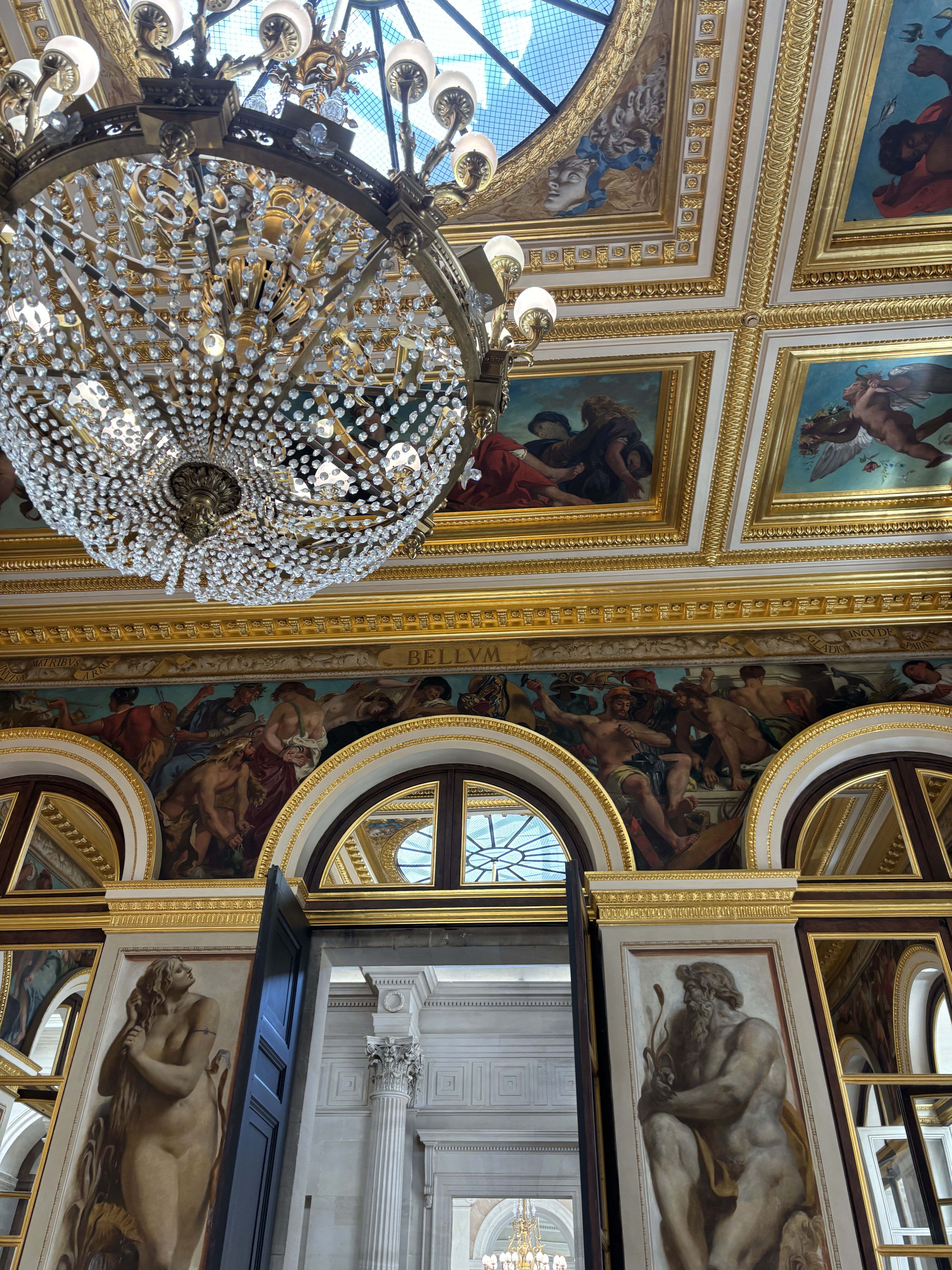
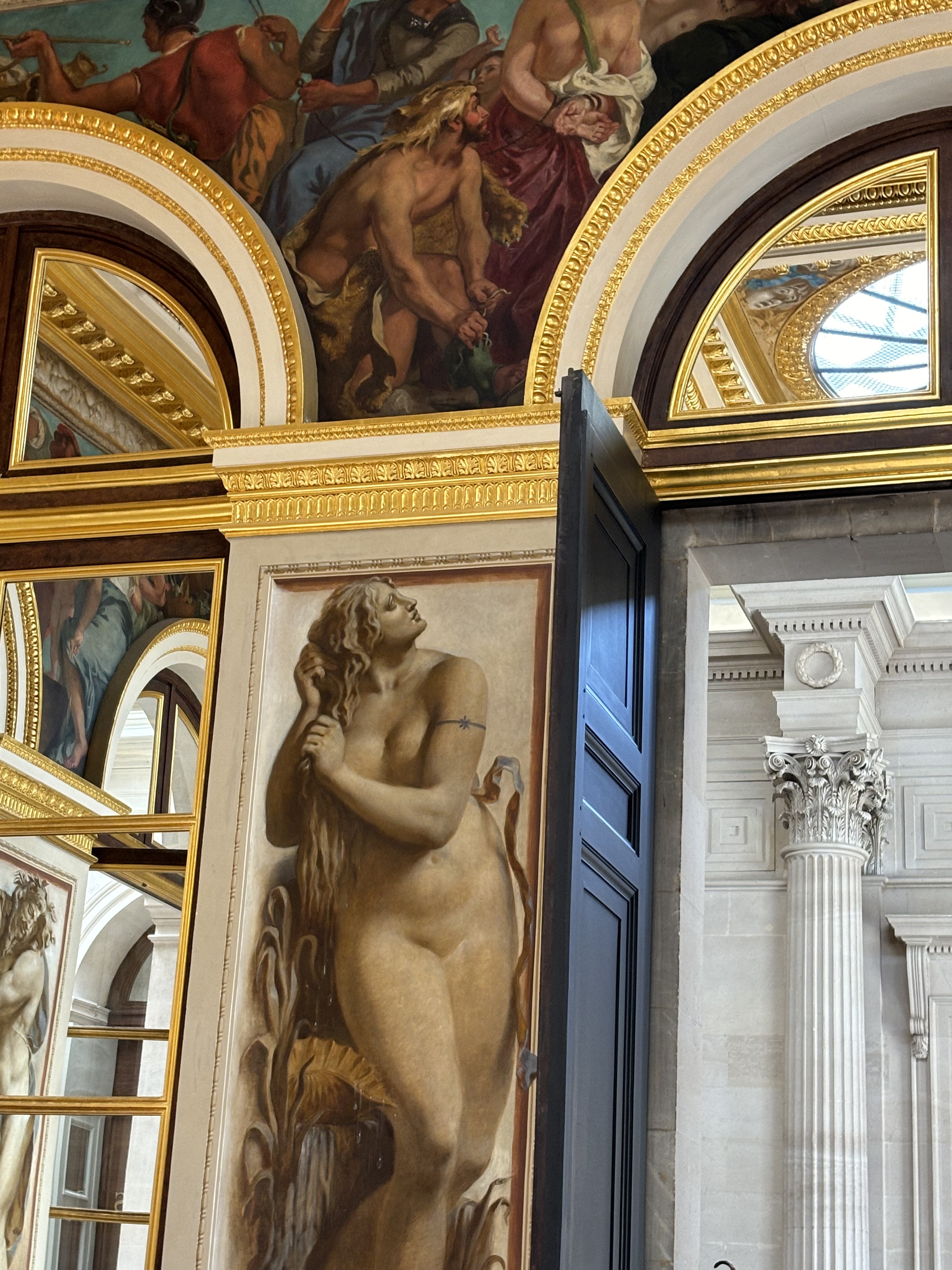
One thing that I would like to discuss that I am unable to directly connect to the French Revolution but that seemed to be a major design element of the building was the ideas of feminism. There were many statues and art works of powerful women or women that represented strong topics. One of these notable situations occurred where a woman had written the rights of women which was based off of the revolutionary text about the rights of man. This was written by Olympe de Gouges and the text of this document was present. Additionally, it is notable that the French revolution gave no voting rights to women when it occurred. The artwork that was drawn and the statues around the national assembly portrayed women of many different body types in the Greek and Roman style artworks. The idea of body positivity was seen in so many of these depictions and plus sized bodies, which are not often seen in these art styles were added to these allegories and stories. It was very nice to see these different body types in the artwork that would typically not depict different body types and it made me happy to see these depictions. It is very hard to find artwork from older periods that shows body types.
 Revolutionary Cities