
Questions to consider: Is there a way to support the Revolution without fighting in it? Was Delacroix successful in aiding the revolutionaries even though he wasn’t willing to fight? Was his artistic contribution meaningful?
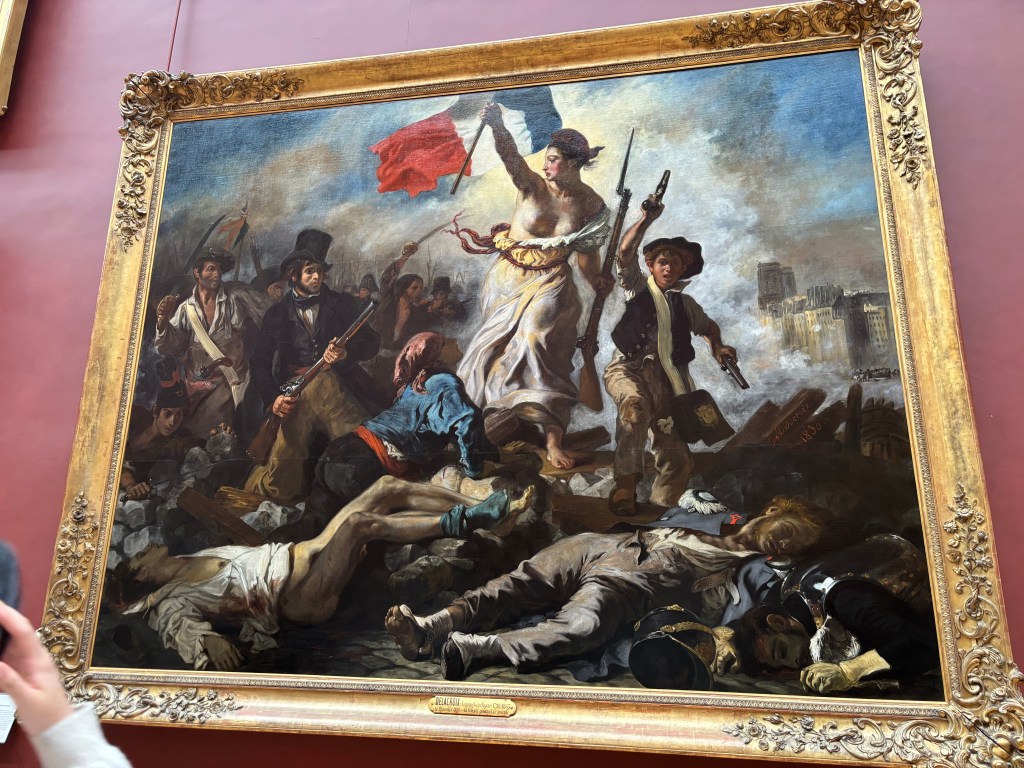
The painting Liberty Leading the People by Eugéne Delacroix is a huge piece of art depicting a scene from the July Revolution. In the center of the painting, Liberty is personified as a woman. The woman is looking over the bodies of the fallen soldiers. She is holding the flag of the French Revolution in one hand, and a musket in the other. The figure is both allegorical and strong. It symbolizes the force, determination, and spirit of the revolution.
The woman (who is a symbol of Liberty), is wearing a Phrygian cap (also the mascot for the 2024 Olympics) which is a symbol of freedom and liberty. The people and fallen soldiers around her are a diverse group of individuals from different social classes. They, like all members of the revolution, were united in the struggle. Fun fact, the boy standing next to the woman in the same position was the inspiration for the young boy in Les Miserables (which we also watched this week). Delacroix’s use of color and strong composition captures the intensity of the Revolution and has made “Liberty Leading the People” a powerful symbol of civil liberty and national Unity.
Even though Delacroix never took up arms in the Revolution, he was in full support of the revolutionary’s cause. He got the inspiration and imagery for this painting from the scenes he saw from outside of his window in Paris. He wanted to help the revolutionaries and thought that propaganda, by way of art, was a way he could contribute to the revolution. As he was dying, he wrote to his brother: “And if I haven’t fought for my country at least I’ll paint for her.” Even though Delacroix created this beautiful piece of art that memorializes the revolution, was this painting or the other works he made during the Revolution helpful or meaningful at the time of the revolution? I would argue that Delacroix was influential in the Revolution and did successfully help the Revolutionary cause. his contribution to the revolutionary cause can certainly be seen as meaningful. “Liberty Leading the People” not only inspired Revolutionaries but continues to serve as a symbol of freedom and resistance. The painting portrays Liberty personified as a woman leading people forward over the bodies of the fallen, brandishing the tricolor flag, which came to symbolize revolutionary France. This imagery has had a lasting impact on French national identity and the collective memory of the revolution.
Therefore, Delacroix’s success in aiding the revolutionary cause, without physically participating in the fighting, lies in his powerful and enduring artistic expressions. His work stimulated the public imagination and morale, supporting the revolutionary ideals profoundly. Through art, Delacroix made a significant and enduring contribution to the revolutionary spirit, demonstrating that support for such causes can take many forms beyond physical combat.
However, one thing to consider, is that Delacroix and other artists’ contributions to the Revolution had a delayed effect on the Revolution. In July 1830, the men fighting were probably not aided or motivated by “Liberty Leading the People”, but French citizens afterward were motivated by the painting. This does not make his contribution meaningless, but it is something to consider when talking about the impact artists or writers can make on a Revolution.
 Revolutionary Cities